
A Construction Cost Comparison

Battery vs Diesel vs Hybrid

Choosing the right power strategy is no longer just about meeting local noise and emission requirements; it is a fundamental shift in project economics. This guide compares the total cost of ownership (TCO), operational efficiency, and environmental impact of the three primary site power configurations.
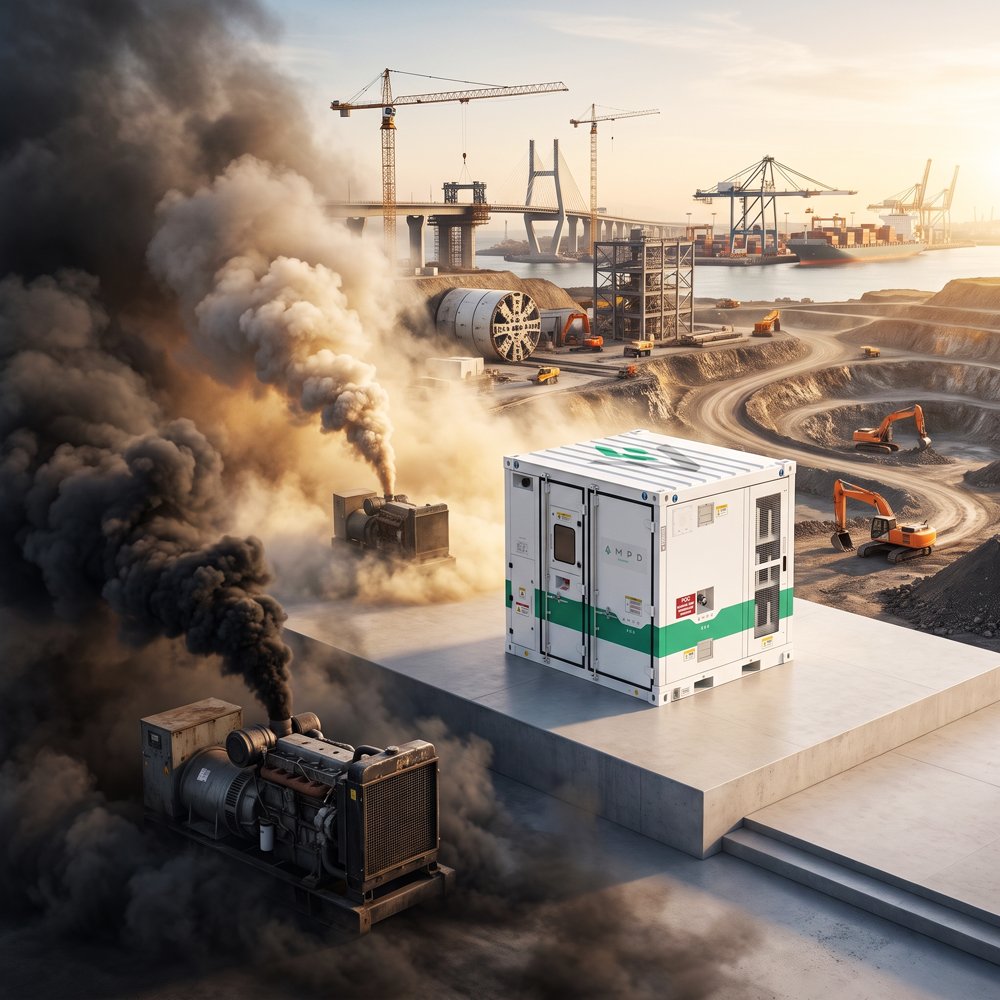
Before selecting your power source, you need to understand the optimal deployment model; Standalone ESS for absolute zero-emissions or Hybrid ESS + Diesel for automated efficiency

Executive Summary

The Financial Shift

While traditional diesel generators have a lower upfront rental cost, their operational expenses (OPEX) are increasingly volatile and inefficient.  Integrating an Ampd Battery Energy Storage System (BESS) typically delivers:

OPEX Reduction

Up to 85% compared to diesel-only setups.

Payback Period

Purchase payback in as little as 1 to 2.5 years.

CO₂ Savings

Up to 90% reduction in site emissions.

Comparison Table

Technical & Economic Comparison

This table outlines how the three systems compare across key performance and cost metrics

Metric
Fuel Efficiency
Maintenance
Power Quality
Noise Levels
Monthly OPEX
Diesel Generator (Only)
Low; often idles at <30% load
High; frequent onsite servicing
Variable; voltage dips during surges
~100 dB(A); restricted hours
High
Hybrid (Ampd + Small Generator)
High; generator runs at peak efficiency
Low; 87% reduction in generator runtime
UPS-like; ±1.5V stability
Near silent; Enables 24/7 work
~50-60% Lower
Full Electric (Ampd + Grid/Solar)
N/A (Zero diesel required)
Minimal; near-zero maintenance
UPS-like; stable and clean power
Near silent; 32x quieter than diesel
~85% Lower

Why "Diesel-Only" is the Most Expensive Option

Traditional generators must be "oversized" to handle the brief, high-torque surges required by tower cranes and hoists.  This leads to:

The Idling Trap

Generators often run for 24 hours just to power 10 hours of work, burning fuel even when equipment is inactive.

Wet Stacking

Operating under 30% load leads to engine damage and shortened lifespans.

Geopolitical Premium

Fuel costs are subject to global market volatility that contractors cannot control.

case studie

Real-World Case Studies

Each project below represents a transition from traditional diesel to an Ampd powered solution. Click the project title to view the full technical report and data.

Project & Location
Superstructure (North Point, HK)
Microsoft Data Center (Melbourne, AU)
Olympia Redevelopment (London, UK)
Residential Development (Hung Hom, HK
Irwell Hill Residences (Singapore)
A W Edwards (Sydney, AU)
Power Configuration
Enertainer 400 powering 2x Tower Cranes
2x Enertainers powering 3x Tower Cranes
3x Enertainers replacing 500kVA generators
Enertainer L (Zero Diesel setup)
Enertainer ESS for PPVC construction
Enertainer L (Hydrogen Charged)
Key Operational Results
85% lower fuel cost and 81% CO2 reduction vs. 2x 400kVA generators.
32% reduction in total cost; 74,345 liters of diesel saved.
70% reduction in operating costs and 192 tonnes of carbon saved.
71% lower operating cost; eliminated all on-site air pollution.
15% lower energy costs; 221,000 liters of diesel prevented.
91% CO2 reduction; saved AUD $48,000 per month in costs.
subheader

Frequently Asked Questions

Can a battery system power a heavy-duty tower crane?

Yes. Ampd ESS units like the Ampd 400 provide up to 595 kVA of peak power, making them purpose-built for the high-torque transients of tower cranes and hoists.

How much does a site save by switching to hybrid power?

A typical hybrid setup (Ampd + small generator) reduces annual fuel consumption by 48% to 60%, leading to a purchase payback period of approximately 2 years.

What are the operational benefits beyond cost?

Switching to an Ampd BESS eliminates refueling downtime, provides 24/7 data transparency via the Enernet platform, and removes the risk of diesel spills and fire hazards.
Ready to power your next project with an Ampd?

Your local specialist can give you a full cost breakdown, fuel savings, & CO₂ avoided for your site.

Industries
The Ampd assurance

We don’t just provide power, we provide peace of mind through rigorous quality standards and world-class components.

STEP 1

Tier-one Battery Technology

The Ampd 200 utilizes CATL LFP cells from the world’s leading manufacturer, rated for an industry-leading 9,000 cycles at 100% depth-of-discharge.

STEP 2

Global Certification

Our NextGen products are certified to IEC and UL standards by SGS, the premier globally recognised product certification body for the ESS industry.

STEP 3

Validated Reliability

Through hundreds of field hours and exhaustive testing, we ensure every unit is worry-free and fully functional right out of the box.

STEP 4

Local Support, Global Warranty

Enjoy a 5-year parts warranty, backed by local service teams and regionally held stock.

Ready to power your next project with an Ampd?

Your local specialist can give you a full cost breakdown, fuel savings, and CO avoided for your site.

get it touch