Estimated based on replacing the equivalent capacity diesel generator consuming 436,000 litres of diesel at £1.40 per litre over the 21 month project duration
A successful UK construction and development company, with a commitment to sustainability, were awarded the contract for a city center student accommodation construction project. With a focus on reducing their carbon footprint across every aspect of their business, one key aspect for consideration was in relation to on site power emissions. As a significant contributor to the overall carbon footprint of a construction project, typically due to the use of diesel generators for tower cranes and other heavy duty construction equipment, they wanted an alternative.
The project was for a 142,000 sq ft purpose-built student accommodation build in a major city in the North West of the UK. As one of the most popular student cities in the country, this property is just a stone’s throw away from renowned universities and sits just minutes away from the railway station. The 1,224-bed scheme topped out at 28 stories, the tallest of three interlinked buildings rising to 81 meters.
The inner city construction project needed reliable power for what would end up being a maximum of 2 tower cranes, 40+ mast climbers, 2 pairs of hoists and site temps. With a drive to reduce its carbon footprint, the developer sought a more sustainable option than diesel generators, which are quite common for large construction projects of this sort. Following successful deployments on other construction sites the builder once again turned to an Ampd as a potential solution to the challenges of the project.
With sustainability being ingrained into the design of the building, including the reduction of their embodied carbon, Solar PV is to be installed on the rooftops and a rainwater harvesting system will be put in place, so carbon reduction needed to be part of the entire build process.
Thanks to some early planning discussions before the project got underway, the Ampd Battery Energy Storage Systems could be considered as an alternative to diesel generators at the very outset. With the integration of some rented office space adjacent to the site, a small 44 Amp 3 phase supply was secured which was perfectly suited to be used to charge an ESS. This all meant that site emissions could be reduced as early as possible with flexibility on the battery requirement as the project ramped up.
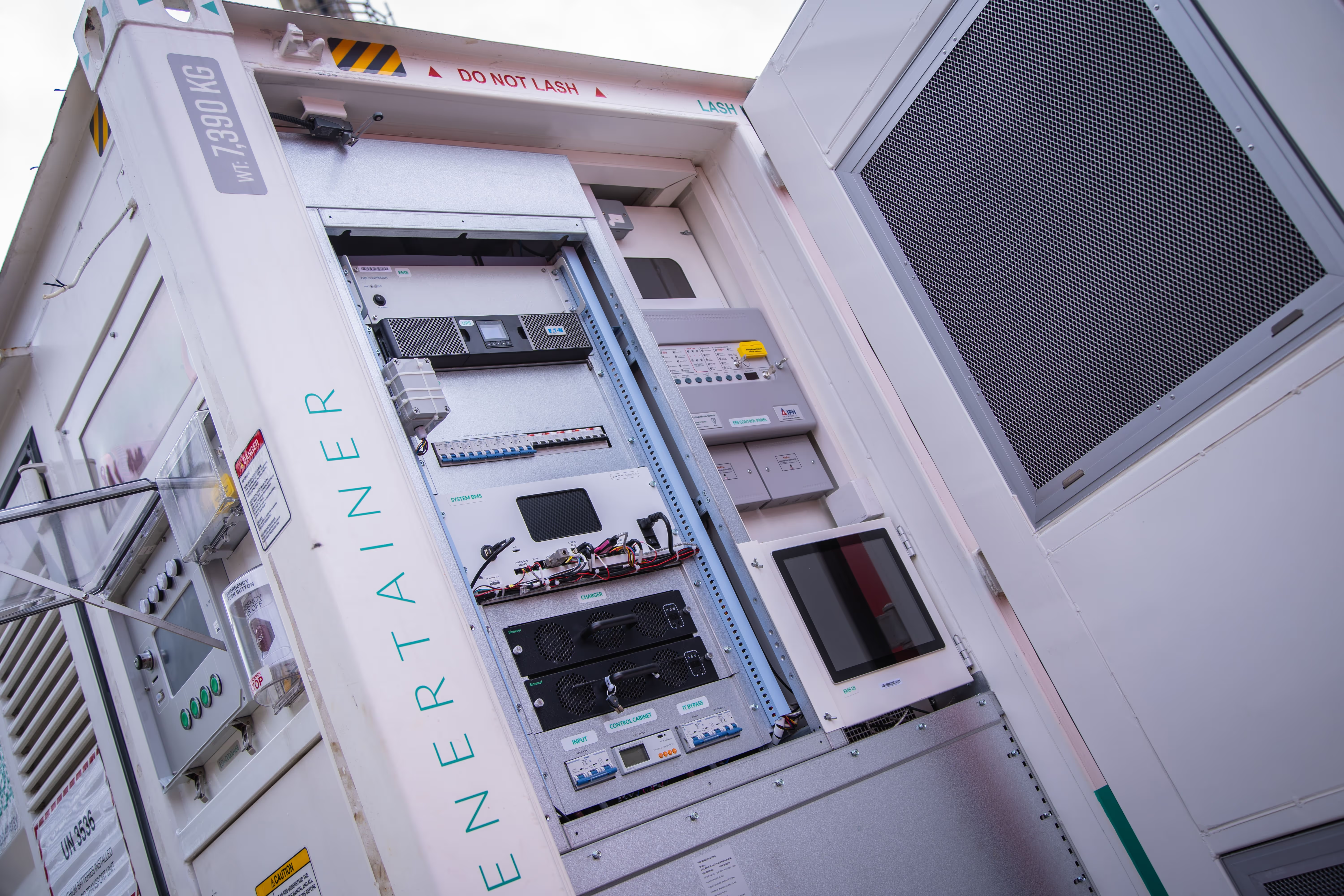
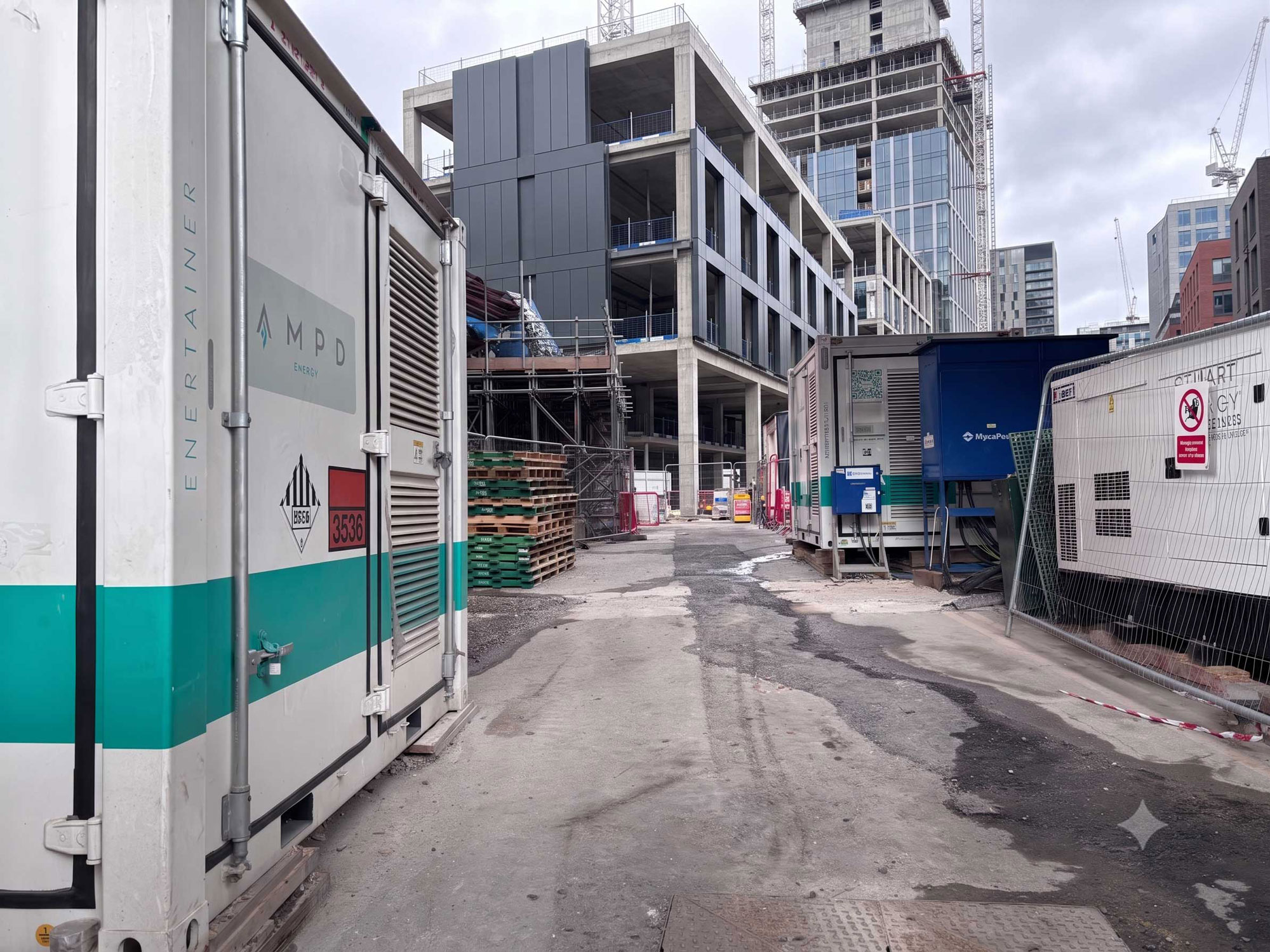
An Enertainer M was deployed in November 2023 for an initial set-up that required power to two tower cranes and a pair of Hoists. After around 6 months or so of smooth operation (May 2024) site activity increased additional mast climbers were deployed, taking the number to over 40. As a result the site upgraded to an Ampd Enertainer L+ to handle the increased load these brought. During winter (January 2025), they upgraded to two Ampd ESS, with the addition of an Enertainer M to run alongside the L+ to cope with the high power demands of the site, which also included the site heaters. This saw the project through to the end of the high power demands of the site approaching completion.
Reliability was one feature that those working on-site quickly noticed. The Enertainer delivered stable power to the site without any disruptions, and required minimal maintenance when compared to diesel generators, across the whole construction period. Built for the construction industry, the Enertainer supplied sufficient on-demand power, while amplifying the small electrical current from the grid. The Enertainer provided the necessary power for the tower cranes to hoist the heavy loads.
To make the strategic decisions to deploy the Ampd Enertainers on, and off, the project, Ampd’s Enernet™ platform was utilized. The connected software enabled monitoring, usage tracking and state of charge to help make informed decisions around the operational performance of the site. The insights Enernet™ provided allowed the site team to make calculated decisions on their power needs as the project progressed.
With Ampd’s Enertainers being used across the 21 month project duration, energy costs were significantly lower than compared to operation with a diesel generator. On-site, the Enertainer system minimized air pollution significantly and reduced noise pollution by up to 30 times as compared to traditional diesel generators, boosting the site's sustainability goals.
The use of ESS in place of diesel generators removed the equivalent of around 1,600+ kVA diesel generator requirement, abated 1,200 tonnes of CO2 (85% reduction) and saved an estimated £420,000*.
Discover how our Enertainers can enhance efficiency while protecting the environment and reducing costs.
DOWNLOAD

"With the inclusion of the Ampd batteries in the early planning phase, we were able avoid any unnecessary delays to the project start and managed to maximize the cost and emissions savings."
Lorem ipsum dolor sit amet, consectetur adipiscing elit

.avif)